How to tell a real catheter from a dangerous one
Search a big shopping site for catheters and you get clear plastic tubes sold by the bag. They are cheap. They come in days. They look close enough.
This page is about telling them apart from the real thing. It sells nothing and links to no shop. It shows you what the rules say and what the labels say, so you can read a listing yourself.
One promise about how it is written. This site says nothing of its own about any product it names. Where a product has a name here, you get the maker's own label or a regulator's own words, quoted, and you can go and read them.
A catheter is a device with a definition
A urinary catheter is not a generic tube. In US law the whole class of device has a written definition:
A urological catheter and accessories is a flexible tubular device that is inserted through the urethra and used to pass fluids to or from the urinary tract.
The guideline that European urology nurses write describes what people are actually given. On the ready-to-use kind:
Sterile catheters with hydrophilic coatings are a ready-to-use solution, with gel on the surface of the catheter or in the wrapping.
So the first mark is the word sterile, and it is on the pack. The next two are there as well. A real catheter has a size and a length. The guideline tells staff to read the size off the packaging rather than trust a colour:
Note, while the colours are international, not every manufacturer uses the colour coding; so, it is necessary to check the packaging and connector for size confirmation.
Neither is a shelf decision. The size is chosen for the person, [EAUN 2025] and the type, tip, length and size are written down when someone starts using one. [EAUN 2025]
Hold a listing up against that. Sterile, a size, a length, and someone who chose them for you. If a listing shows none of it, that gap is the finding.
On using one more than once, the same guideline's advice to staff reads:
Use a sterile single-use intermittent catheter to prevent cross-contamination in clinical, rehabilitation, and long-term care settings
Read the last clause. That is a rule for wards and care homes, where the worry is one person's catheter reaching another. It is not a mark of the real thing. The guideline treats single-use as the default, and it allows a reusable catheter where single-use ones are not to be had. [EAUN 2025]
Coating is a preference, not a mark either. Some real catheters are coated or come with their own gel. Others are plain and are used with a separate lubricant. [EAUN 2025] What the guideline recommends, with "IC" short for intermittent catheterisation, is this:
Hydrophilic-coated or pre-lubricated catheters should be used for IC
A plain one from a regulated maker is still the real thing.
What a label has to say
In the US, a device that may be sold only on a practitioner's order has to say so on its own label, in fixed words:
The symbol statement “Rx only” or “℞ only” or the statement “Caution: Federal law restricts this device to sale by or on the order of a ___”, the blank to be filled with the word “physician”, “dentist”, “veterinarian”, or with the descriptive designation of any other practitioner licensed by the law of the State in which the practitioner practices to use or order the use of the device
Other countries mark a medical device in their own ways, and the mark is on the box. For Great Britain the regulator puts it in one sentence:
Medical devices placed on the Great Britain market must have a UKCA marking or a CE marking, depending on which legislation the device has been certified under.
What matters is that a real device is labelled as one. If a listing shows you no such marking at all, that gap is the finding.
Everything above is for recognising a real one. None of it is a way to get hold of one. A listing that passes every test on this page has still not been chosen for you, and nobody has looked at you to pick a size or a type.
What the listings actually looked like
The pictures below are one person's own shopping history. Nothing in them is a link.
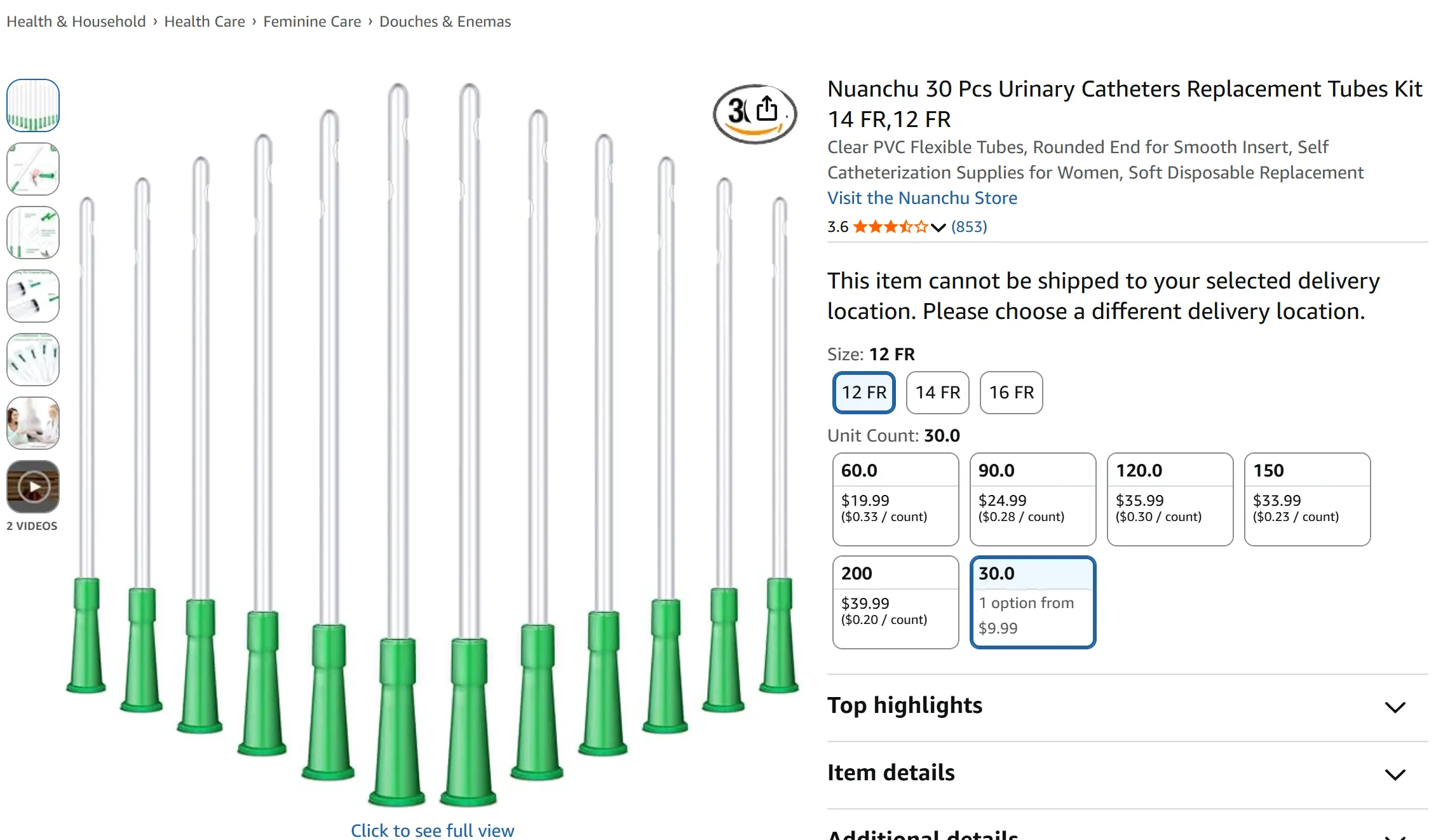
Read the trail of categories along the top. That trail is the shop's own filing, not the seller's wording. A urinary device is used by women and by men, and neither of them is shopping for a douche.
Then read the title. It offers spare tubes and a count, in the way a shop lists a refill pack. It does not name a device, because it is not selling one.
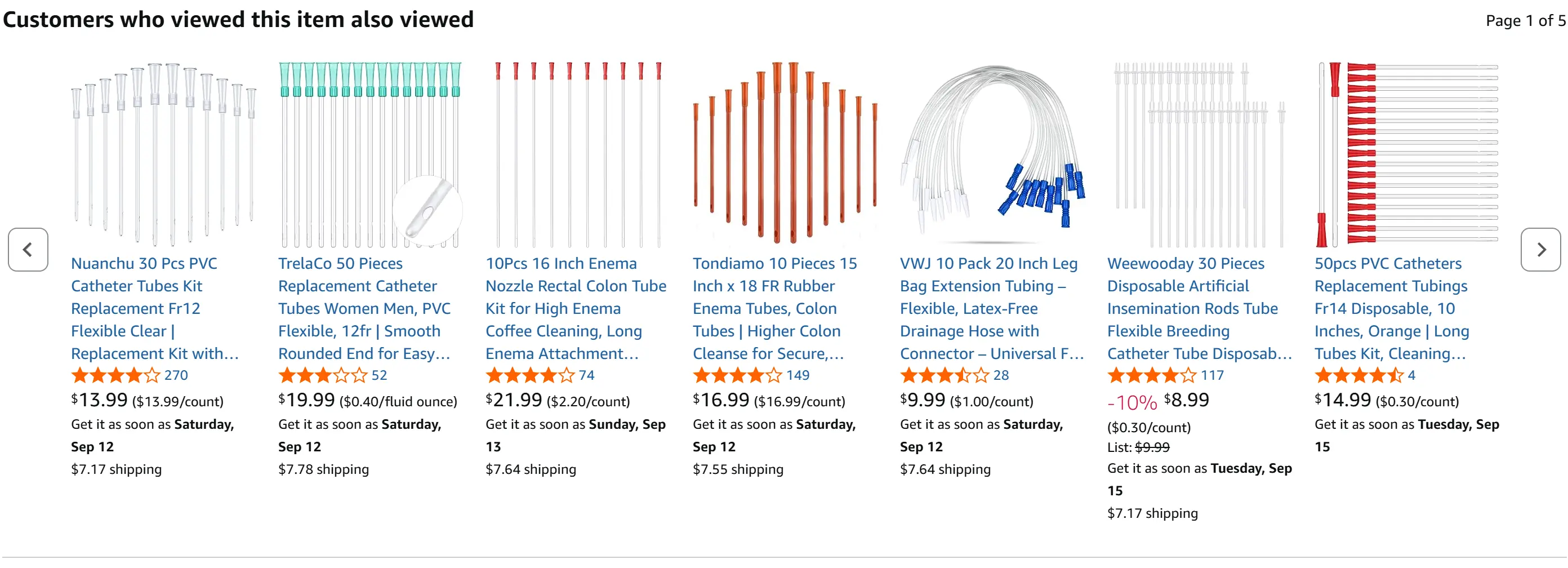
A shop groups an item with the items it resembles. Look at the company this one keeps. Nothing in that row is a urinary device, and the row is the shop telling you so.
What one label says
The same searches bring back wipes and bottles. One of them is a surface disinfectant, registered with the US Environmental Protection Agency. Here is its own approved label, quoted, with nothing added:
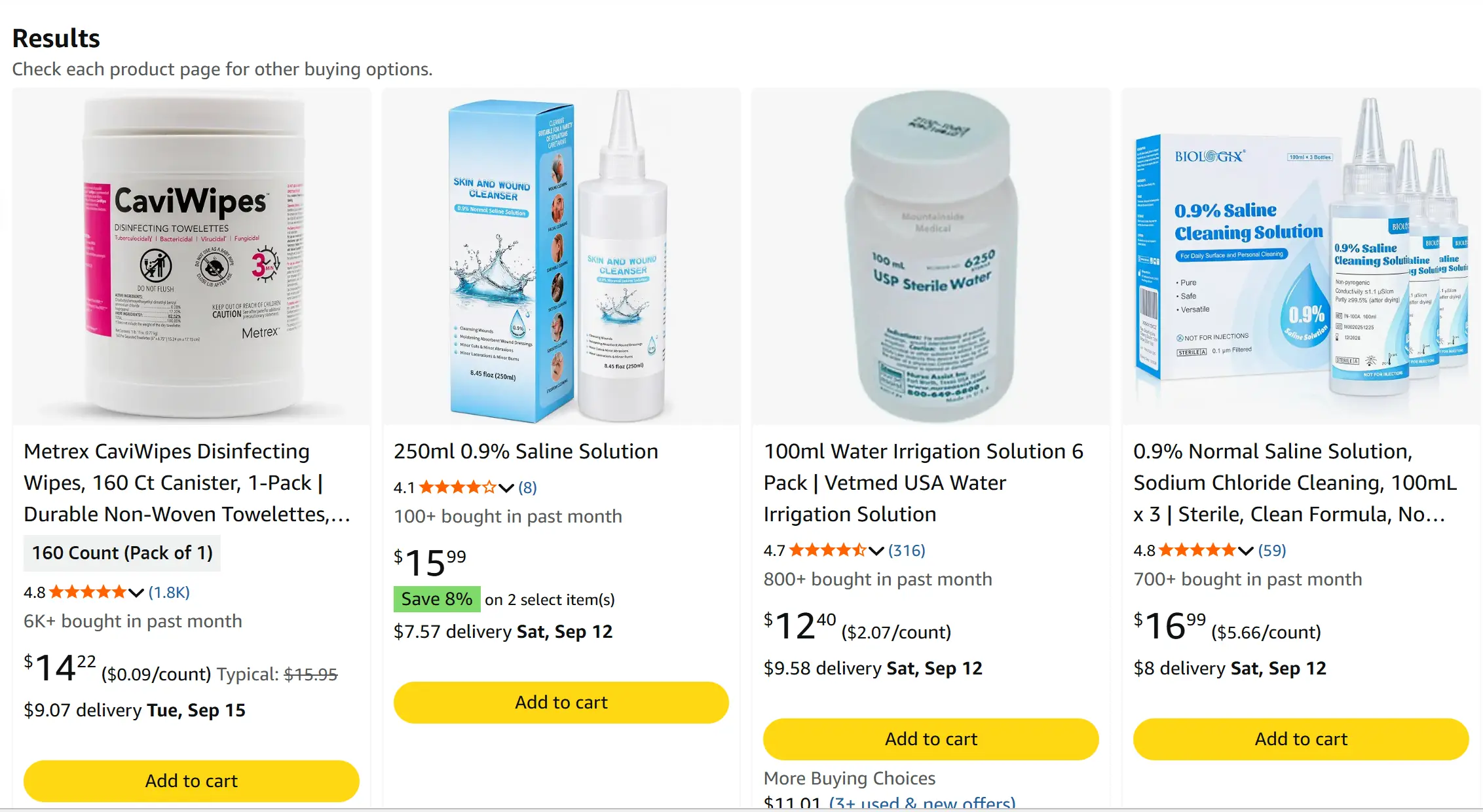
What the label says
CaviWipes is a multi-purpose [disinfectant] [cleaning product] [cleaner] for use on hard, non-porous inanimate surfaces.
What the label says
Harmful if absorbed through skin. Causes moderate eye irritation. Avoid contact with eyes, skin or clothing.
What the label says
This product is not to be used as a terminal sterilant/ high-level disinfectant on any surface or instrument that (1) is introduced directly into the human body, either into or in contact with the bloodstream or normally sterile areas of the body, or (2) contacts intact mucous membranes but which does not ordinarily penetrate the blood barrier or otherwise enter normally sterile areas of the body. This product may be used to preclean or decontaminate critical or semi-critical medical devices prior to sterilization/high-level disinfection.
Those are the label's words, not ours.
And the job the wipes were bought for does not call for a disinfectant at all. On washing before catheterising, the nurses' guideline asks for two things, and the second is a thing not to do:
Clean the urethral meatus with water and pH-neutral soap
Do not use antiseptic lubricants for IC routinely
Soap and water. Nothing in the results above is either.
The same results held saline sold as a cleaning solution and a bottle sold for animals. This page does not name either of them, and here is why. We could not reach the maker's own label for either. Without the label we would be telling you a thing about a named product on our own say-so, and that is the one thing this page will not do. No label, no claim.
The gel is worth a line of its own, because the kit did include the right kind. On that, the nurses' guideline says:
Sterile lubricants are always for single use. An open package should not be used again.
Use lubricant in both women and men when using a non-coated catheter
The route that gets the right thing
There is a reason people end up in a search box. Asking is hard, and that is what this whole site is about. But a shop cannot look at you, and a listing cannot answer a question.
The choice of catheter should consider the patient assessment, patient preference, limitations or disabilities, cost-benefit, cost effectiveness, ease of use, and storage issues. The patient should be given guidance on selecting the best product for their needs, recognising that their needs may change over time.
Preference is on that list, and the guideline has one of its own about material:
PVC-free catheters should be used for IC to reduce pain and burning
That is a comfort recommendation and a thing to ask about, not a mark of a fake. A PVC catheter from a regulated maker is a genuine device.
Cost-benefit is on the list as well, and the guideline sets out the cost side in its own figures. Infection is the most common. [EAUN 2025] Its table of complications gives the share affected, and the second figure is for users whose bladder problem is not a nerve disorder:
62%–77% among IC users with a neurogenic disorder and 38%–42% among IC users with a non-neurogenic disorder.
The same table lists inflammation of the urethra. [EAUN 2025] In men it lists inflammation of the testicle and the tube behind it. [EAUN 2025] And it lists a narrowing of the urethra, mostly in men and rarely in women. [EAUN 2025] That last one is the reason for one of its recommendations:
Hydrophilic-coated catheters to prevent urethral strictures should be used
One more line is worth knowing before a test strip is ever dipped. Bacteria in the urine come with catheterising, and on their own they are not a reason to treat:
Bacteriuria is acquired at the rate of 1%–3% per catheterisation. Asymptomatic bacteriuria does not require treatment.
In all IC users, only treat symptomatic UTI
That is the trade-off a clinician weighs with you, and it is not one a listing mentions.
Who signs for it varies from country to country:
The practitioner authorised to prescribe IC will depend on the jurisdiction and local health care organisation policy.
If you would rather not open the subject out loud, the Doctor Brief is a sheet you can hand over instead.
Getting it once it is prescribed
The rest of this page is the part people picture going wrong: hunting for supplies, explaining yourself at a counter, some standing errand with your name on it. Mostly it is not like that. Once a clinician has agreed, what follows is admin, and much of it happens on a phone.
Two things above are the reason supply is a repeating arrangement rather than a purchase. A single-use catheter, the guideline's default, [EAUN 2025] is used once and binned, and where it is not already coated the lubricant is single use too. [EAUN 2025] So you are not buying an object. You are being set up with a standing quantity of them, gel included. [EAUN 2025]
In England, the ordering is online and it repeats
You can order repeat prescriptions online by logging into the NHS App or the NHS website. You can choose a high-street pharmacy to collect your prescription from. Some pharmacies may offer delivery.
And on where it goes:
When your prescription is ready you can pick it up in person, or your GP surgery may be able to send it to a pharmacy of your choice. If you choose a pharmacy, the pharmacy may be able to deliver your medicine to you or let you know when it's ready for you to collect.
Note the hedges. "May offer delivery." "May be able to deliver." Whether anything comes to your door depends on the pharmacy you pick, and that is a question to ask them. What the NHS does state flatly is that you order online, and that you choose who dispenses it.
One more thing, for anyone who leaves an appointment and then loses their nerve for a fortnight:
Most prescriptions are valid for 6 months from the date they are signed by a doctor or nurse.
Most, not all. But a prescription is not a thing that expires the same week.
What it costs in England
At the time this page was last checked, the NHS stated:
The current prescription charge is £9.90 per item.
That is set annually, so check the date at the foot of this page against today's. The per-item part matters more here than on most pages, because single-use supplies mean a lot of items. There is a scheme built for that shape:
A PPC covers all your NHS prescriptions, including NHS dental prescriptions, no matter how many items you need.
The NHS puts one question ahead of that one, and this page keeps its order:
Check if you can get free prescriptions before you apply for a PPC.
This section is England. Charges work differently in Scotland, Wales and Northern Ireland, and this site has no source for those, so it says England and stops rather than guessing.
In the United States it runs through cover, not a counter
Medicare states that it covers this:
We cover intermittent catheterization when the patient meets basic coverage criteria, and the patient or caregiver can do the procedure.
Read "basic coverage criteria" carefully, because that is where the honest answer lives. The policy behind them is about permanent retention and permanent incontinence:
Urinary catheters and external urinary collection devices are covered to drain or collect urine for a beneficiary who has permanent urinary incontinence or permanent urinary retention. The beneficiary must have a permanent impairment of urination.
Nothing found in any Medicare material says paruresis meets that, and this page will not suggest it does. Whether it applies to a particular person is a question for a prescriber and an insurer.
What Medicare does say about how it is decided is familiar:
The patient’s medical records must support the medical necessity for the urological supplies and must be available, if asked, for us to consider them reasonable and necessary.
It comes back to what the drug testing page found in a different rulebook: what has been written down beforehand is what decides it. That is an argument for the appointment, not for a workaround.
Everywhere else
We looked for the same kind of published route in other countries and did not find one we could quote. That is a statement about what we could reach, not a finding that nothing exists. The only general thing on the record is the line above: who may prescribe depends on where you are. [EAUN 2025]
For the ordinary problems that come with any prescribed supply, the ones that are not in the list below, the nurses' guideline is short:
If problems persist or complications occur, a medical consultation should be made.
Four things that need urgent care, not an appointment
Not being able to go in a public toilet and then going at home is not an emergency. Being suddenly unable to pass any urine anywhere — at home too — with a bladder that is full and painful, is. That is acute urinary retention, and it needs emergency care whatever caused it, paruresis included.
[NIDDK]A catheter that will not pass or will not come out, or part of one left behind, is the second. The nurses' guideline sends it straight to a specialist:
In the event of inability to catheterise, seek advice of a urologist
Blood that does not clear, or bleeding from the urethra, is the third. The same guideline lists visible blood in the urine among its reasons not to catheterise at all. [EAUN 2025]
The fourth is a high temperature or shaking chills after catheterising, with or without pain in your side or back. That points at an infection of the upper urinary tract:
Pyelonephritis is suggested in case of fever (> 38°C), chills, flank pain, nausea, vomiting or costovertebral angle tenderness, with or without the typical symptoms of cystitis
Guidelines give the reason for the hurry:
It is vital to differentiate as soon as possible between pyelonephritis with or without risk factors, such as obstructive pyelonephritis, as the latter can rapidly lead to urosepsis.
This page was last checked on .
Hand this to a doctor